|
|
Our web pages are a redesigned
In case you will not be transfered to the page of the new version
within 1 second
pleaase use this LINK
| |
Keramische Werkstoffe sind anorganisch und
nichtmetallisch. In der Regel werden sie bei Raumtemperatur aus einer
Rohmasse geformt und erhalten ihre typischen Werkstoffeigenschaften
durch einen Sintervorgang bei hohen Temperaturen.
Unter Technischer
Keramik werden keramische Produkte für technische
Anwendungen verstanden.
Entsprechend ihrer chemischen Zusammensetzung gliedern sich die
Werkstoffe der Technischen Keramik in die Hauptgruppen (siehe
auch: Seiten im Brevier):
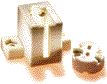
Diese Werkstoffe aus natürlichen
Rohstoffen vereinen in sich die grundlegenden elektrischen,
mechanischen und thermischen
Eigenschaften der Keramik. Wesentliche Bestandteile dieser mehrphasigen
Werkstoffe sind Ton und Kaolin, sowie Feldspat und Speckstein als
Silikatträger. Weitere Komponenten wie Tonerde und Zirkon (ZrSiO4) werden zur Erzielung spezieller
Eigenschaften eingesetzt.
|
 |
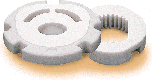
Die Werkstoffe dieser Gruppe bestehen im
wesentlichen (›90%) aus einphasigen und einkomponentigen Metalloxiden.
Diese Materialien sind glasphasenarm oder glasphasenfrei. Synthetische
Rohstoffe mit hohem Reinheitsgrad entwickeln bei sehr hohen
Sintertemperaturen gleichmäßige Gefüge mit sehr guten
Eigenschaften.
|
 |
NICHTOXID-KERAMIK
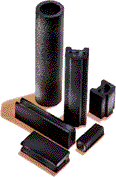
Zu dieser Gruppe gehören keramische Werkstoffe, z.B. aus
Verbindungen von Silizium und Aluminium mit Stickstoff oder
Kohlenstoff. Generell weisen Nichtoxid-Keramiken einen hohen Anteil an
kovalenten Bindungen auf, die ihnen, auch bei hohen
Einsatztemperaturen, sehr gute mechanische Eigenschaften verleihen. Zu
den Nichtoxid-Keramiken zählen:
|
 |
In der Übersicht aller
Werkstoffe nach DIN 60 672 sind alle wirtschaftlich
bedeutenden Keramiken aufgeführt.
|
|
| . |
|
28. September 2004
|
|
|
|
|



 Werkstoffe

